Why the question arises at all
In northern latitudes, twilight does not disappear as usual in summer
The start of Isha is tied to the disappearance of evening twilight, and the start of Fajr to the appearance of morning twilight. In northern regions a bright band stays in the sky in high summer, so the usual sign comes late or, further north, not at all. This is not a theological technicality but an astronomical fact that calls for a clear, uniform rule.
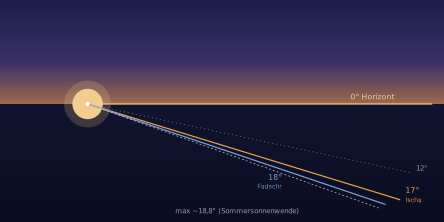
At 47.8°, even at the summer solstice the sun sinks to about 18.8° below the horizon. So the 17° and 18° angles are reached, but only close to midnight. At the solstice both lie less than two degrees above the lowest point: Isha would fall shortly before 1 am and Fajr shortly after, almost together. This is exactly why we set Fajr and Isha by the one-seventh rule as an ease.
Our reference
We follow the Muslim World League
Our authority is the resolution of the Islamic Fiqh Council of the Muslim World League on prayer and fasting times in high latitudes. The resolution divides the earth into three zones. The European Council for Fatwa and Research confirms this approach and does not oppose it.
45° – 48°
The signs can in principle be seen in every 24-hour day. Because we are close to the boundary, Fajr and Isha would fall together near midnight in high summer. Because of this hardship we set both by the one-seventh rule.
48° – 66°
Some signs are missing on certain days. Proportional estimate based on the nearest clear latitude (reference 45°).
above 66°
Signs absent for long periods. Estimate.
The 48° line runs only about 18 km north of the mosque.
Freilassing lies at about 47.8°, only just in the first zone. So as a rule we pray at the actually calculated times. Only Fajr and Isha are set by the one-seventh rule, to avoid the hardship of a start near midnight in summer.
The calculation
Fajr and Isha by the one-seventh rule, Muslim World League as reference
The basis is the Muslim World League. With its angles, Fajr (18°) and Isha (17°) would both fall near 1 am in high summer and almost coincide. To avoid this hardship, we set Fajr and Isha by the one-seventh-of-the-night rule. In the software this adjustment can only be set for both prayers together. The calculation runs on Mawaqit.
Ease through the one-seventh rule
Because by the angles alone Fajr and Isha would both fall near 1 am in high summer, we set their start by the one-seventh-of-the-night method. The night from sunset to sunrise is divided into seven equal parts. Isha begins after the first seventh, Fajr one seventh before sunrise. This keeps both prayer times within a reasonable range.
These are exactly the times our display shows for that day. This ease rests on the recognised rules for avoiding hardship in high latitudes. All other prayers follow the actually calculated times unchanged.
In line with the mosques nearby
Several mosques in our region set Isha in summer about one and a half hours after Maghrib, to avoid the hardship of a very late start. Our method leads to almost the same time. This agreement matters to us, because uniform prayer times in the area spare worshippers confusion and strengthen unity. A fixed interval of one and a half hours between Maghrib and Isha is also among the solutions the European Council for Fatwa and Research explicitly allows for high latitudes.
In the shortest nights
For those praying at home: if Isha still comes very late in the few brightest summer weeks, scholars consider it permissible to combine Maghrib and Isha at Maghrib time. The condition, however, is that one goes to sleep straight afterwards. The permission applies only under this condition.
FASTING AND IMSAK
Those fasting follow the true dawn
The Fajr time shown is a prayer time that is deliberately later in summer because of the one-seventh rule. For fasting, however, the true dawn counts, al-fajr as-sadiq, which comes much earlier in summer. Those fasting stop eating and drinking at imsak, not at the prayer time shown.
This applies to every fasting day, not only Ramadan: also voluntary fasts on Mondays and Thursdays, the white days or Ashura. We show the exact imsak for each day separately.
SOURCES
What this method is based on
Islamic Fiqh Council of the Muslim World League, Mecca: Resolution on prayer and fasting times in high latitudes, with the three-zone division (45°–48°, 48°–66°, above 66°) and the angles 18° for Fajr and 17° for Isha.
European Council for Fatwa and Research: confirms this approach and explicitly allows eases for European summers, including a fixed interval of one and a half hours between Maghrib and Isha and combining the two prayers.
praytimes.org (Hamid Zarrabi-Zadeh): open reference for the astronomical calculation, on which Mawaqit among others is built. Definition of the one-seventh rule: night from sunset to sunrise, Isha after the first seventh, Fajr at the start of the last seventh.
Answers to common questions about our prayer times.
Quick answers
Apps use different angles and special summer rules. Our reference is the Muslim World League, and for Fajr and Isha we apply the one-seventh rule in summer. An app with other settings shows other times.
Because in summer the sun stays close to the horizon for longer. The point where it is 17° below is reached only late, so Isha is much later than in winter.
We apply it to Fajr and Isha as an ease, so that neither falls near midnight. The other prayers follow the actually calculated times.
The Fajr time shown is a prayer time under the one-seventh rule. Imsak, by contrast, follows the true dawn, which comes hours earlier in summer. Those fasting stop eating at imsak, not at the eased prayer time shown.
It follows the resolutions of the Muslim World League and has been adopted by the community's board for a uniform practice.